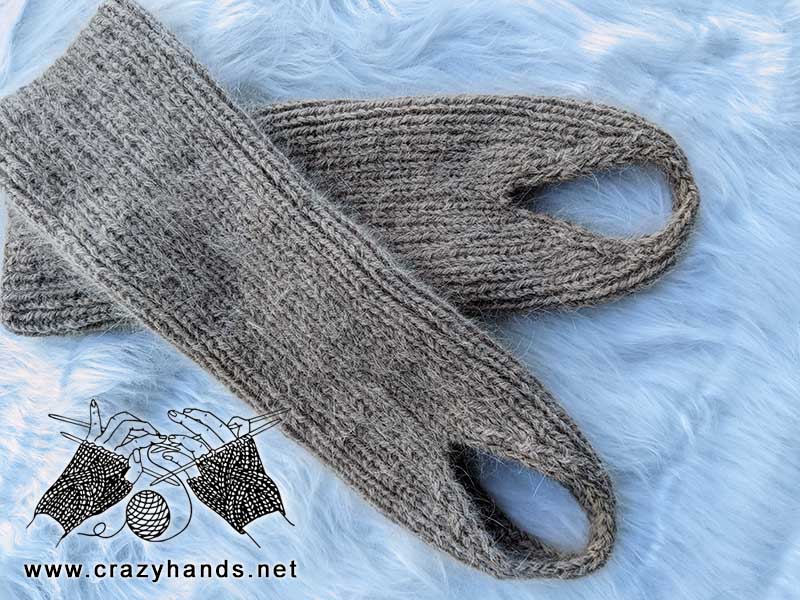

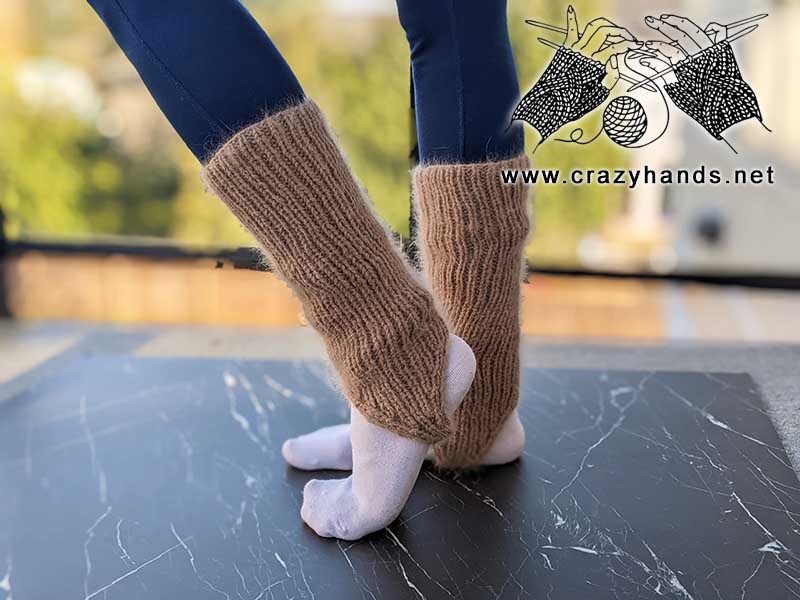
Knitting materials and tools:
Double pointed or circular (80 cm) needles 3.5 mm (US 4).
Long mink wool (Cashmere) yarn – 75% wool, 25% nylon: 50 grams – 350 m per skein. Note: Knit with 3 strands of main yarn, or 2 strands of main and 2 strands of reinforcing (partner) yarn together. Reinforcing yarn adds extra stretch to your warmers.
Weight Category – Fingering. Quantity – 1.5 balls.
Yarn needle, stitch marker.
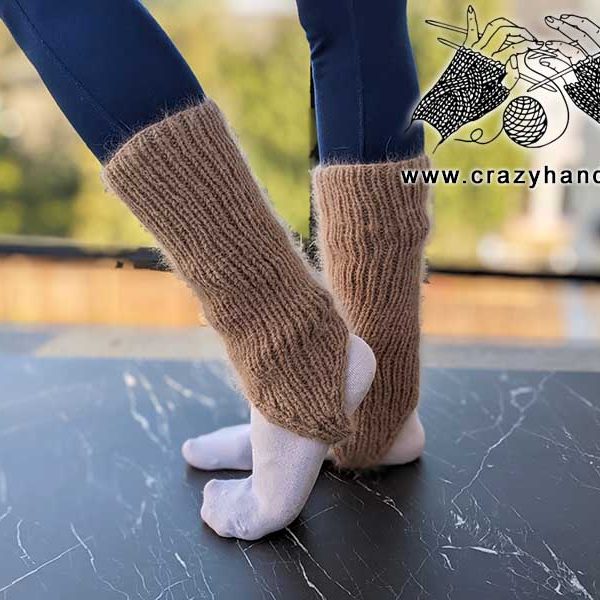
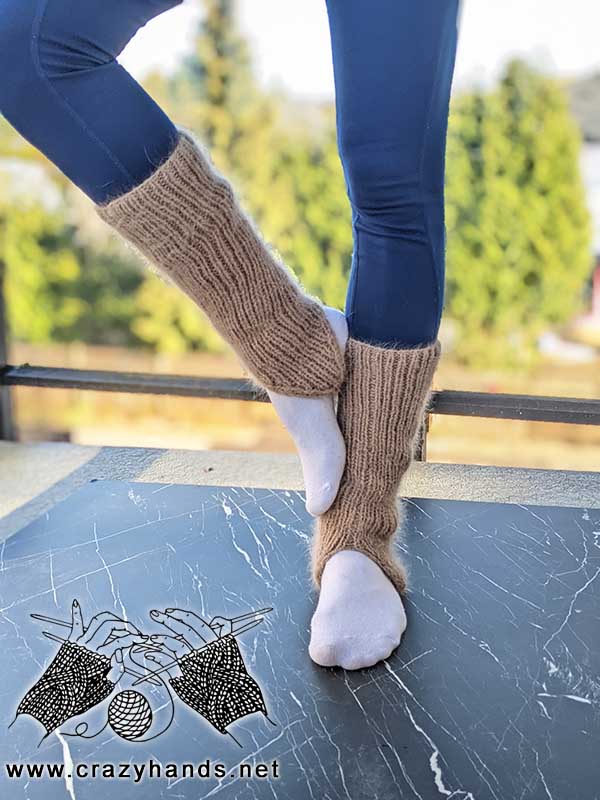
Knit women’s stirrup leg warmers size:
Size: Designed to fit an average woman’s leg.
Gauge: 19 stitches = 4 inches in stockinette
Common abbreviations of knit stitches:
k – knit
k2tog – knit two together
k3togL – knit three together, left-leaning decrease: slip 1st stitch knitwise, k2tog, pass slipped stitch over.
k3togR – knit three together, right-leaning decrease: skpo, return stitch to left needle, pick up next stitch and pass it over, return stitch to right needle.
p – purl
sel s – selvage stitch: always slip the first stitch knitwise, work to the last stitch, purl the last stitch
skpo - Slip, Knit, Pass Over: Slip one stitch to the right needle knitwise, knit in the next stitch, and drop this stitch off the left needle, insert the left needle into the slipped stitch, pass it over the knit stitch and it’s done.
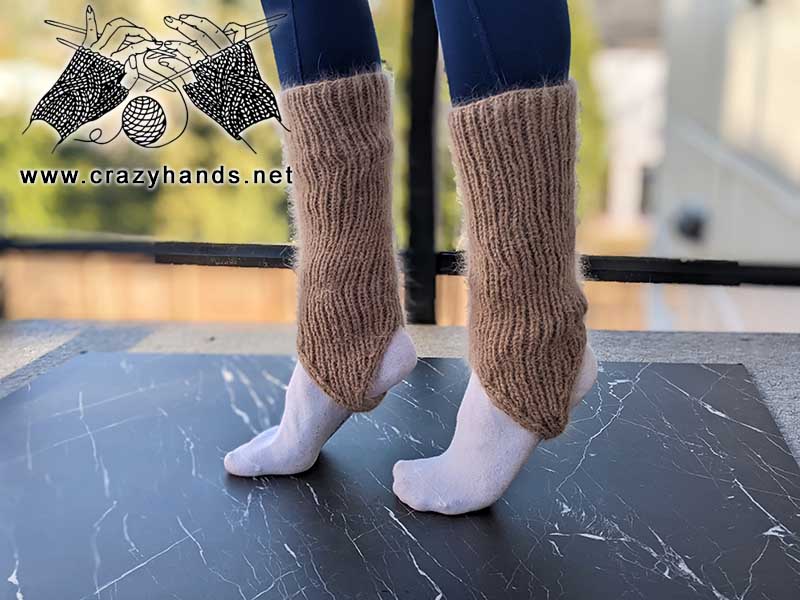
Women’s stirrup leg warmers knitting pattern:
Cast on 52 stitches or any other number multiple of 4.
Round 1: [k1, p1] – repeat around.
Repeat Round 1 until the leg warmer reaches 27-28 cm (11 in).
Heel opening section:
Divide all stitches into two equal parts. In my case, 26 stitches on each side. We will work only the first part for now.
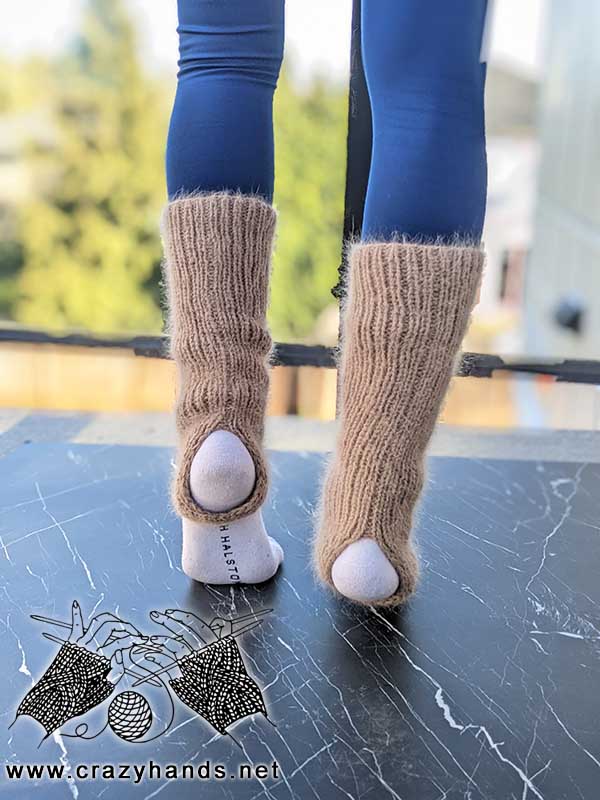
Row 1: [k1, p1] – 12 times, skpo. (25) No matter how many stitches you have (it will be an even number), decrease 1 stitch at the end of Row 1 to get an odd number.
Row 2: slip 1 purlwise, [k1, p1] – 12 times.
Row 3: sel s, p1, k3togL, p1, [k1, p1] – 7 times, k3togR, p1, sel s. (21)
Row 4: sel s, [k1, p1] – 9 times, k1, sel s.
Row 5: sel s, p1, [k1, p1] – 9 times, sel s.
Row 6: Repeat Row 4.
Row 7: sel s, p1, k3togL, p1, [k1, p1] – 5 times, k3togR, p1, sel s. (17)
Row 8: sel s, [k1, p1] – 7 times, k1, sel s.
Row 9: sel s, p1, [k1, p1] – 7 times, sel s.
Row 10: Repeat Row 8.
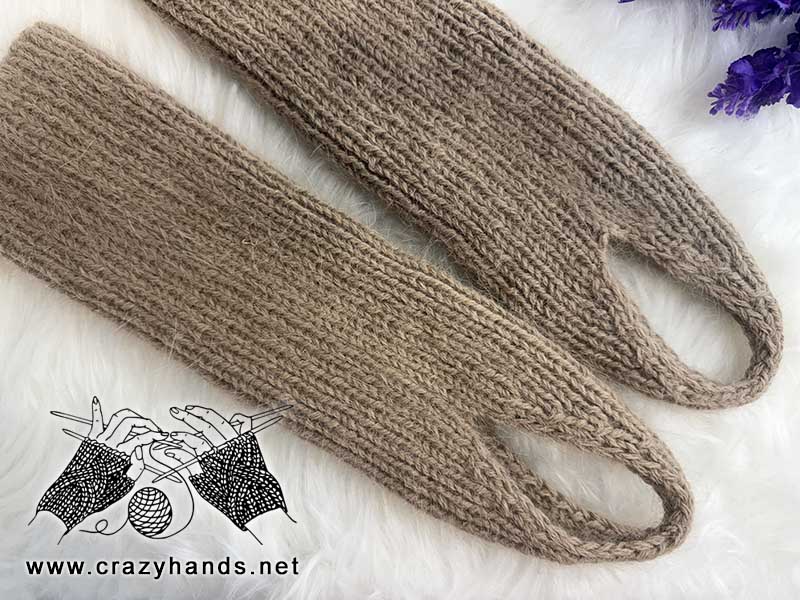
Row 11: sel s, p1, k3togL, p1, [k1, p1] – 3 times, k3togR, p1, sel s. (13)
Row 12: sel s, [k1, p1] – 5 times, k1, sel s.
Row 13: sel s, p1, [k1, p1] – 5 times, sel s.
Row 14: Repeat Row 12.
Row 15: sel s, p1, k3togL, p1, k1, p1, k3togR, p1, sel s. (9)
Row 16: sel s, [k1, p1] – 4 times, k1, sel s.
Row 17: sel s, p1, [k1, p1] – 4 times, sel s.
Row 18: Repeat Row 16.
Row 19: sel s, p1, skpo, k1, k2tog, p1, sel s. (7)
Row 20: sel s, k1, p3, k1, sel s.
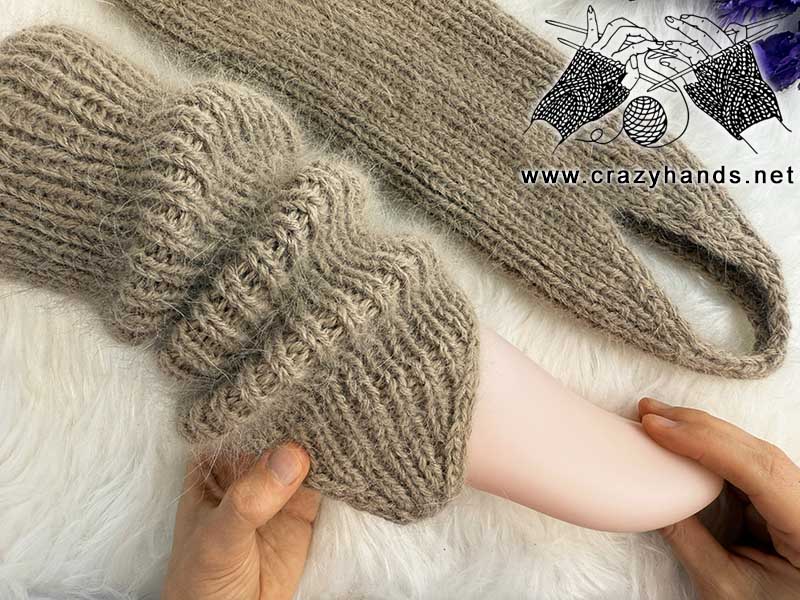
Row 21: sel s, k2tog, k1, skpo, sel s. (5)
Row 22: sel s, p3, sel s.
Row 23: sel s, k3, sel s.
Row 24: Repeat Row 22. Repeat Rows 22–23 to form the heel opening, adjusting for the foot arch.
Cut the yarn, leaving a short tail. Leave the live stitches on the needle or transfer them to a stitch holder.
Turn your work, join new yarn, and repeat the pattern from Row 1.
Leave a 20–25 cm yarn tail, align 5 stitches on each side, and graft them with a yarn needle using the Kitchener stitch. You can watch this part at the end of the video. Weave in all ends.
Repeat the pattern for the second leg warmer.